The rule of right triangles and the man who discovered it
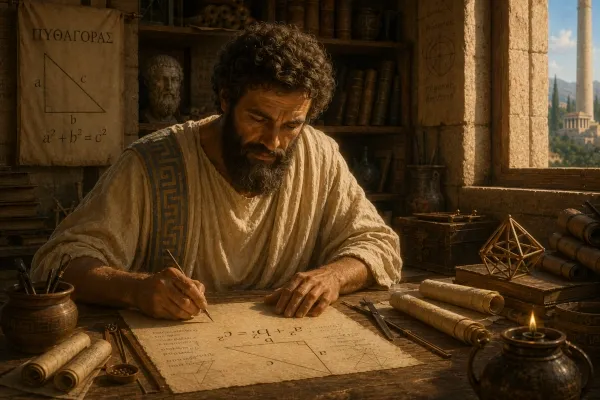
Pythagoras' theorem: two plus one sides of a triangle
What determines the shape of a triangle? Or almost every triangle? Let discuss the so-called right triangles. These triangles have one angle that is 90 degrees, simply speaking two of its sides are perpendicular to each other like a wall is perpendicular to the floor. These two sides are called catheti. The 3rd side is called hypotenuse. The hypotenuse is the longest side of a right triangle, and it is opposite to the right angle.
The reader may already know that there is rule that defines the lengths of all three sides of a right triangle. That rule is called after the ancient Greek mathematician Pythagoras. He lived many many years ago, when there were no calculators and messengers. Humanity even didn't invent inks at that moment, at least inks that are not washed away.
It makes sense to ask: who actually was this Pythagoras, and how did a single theorem about triangles end up attached to him for over two thousand years?

Pythagoras' theorem is a rule about right triangles. It says that the square of the hypotenuse (the side opposite the right angle) is equal to the sum of the squares of the other two sides. In other words, if you have a right triangle with sides a, b, and c, where c is the hypotenuse, then a² + b² = c². This theorem is very useful in many areas of mathematics, science, and engineering.
Definition: In any right triangle, the square of the hypotenuse equals the sum of the squares of the other two sides.
It is so simple "a squared plus b squared equals c squared" but it is so powerful. The best variables for this expression are 3, 4, and 5. You can describe it using fingers of your arm. You have 3 and 4, and then you have 5!
Who was Pythagoras
Pythagoras was a Greek mathematician and philosopher who lived maybe 26 centuries ago. Not every reader knows his other achievements in other areas besides mathematics, but everyone recognizes the Pythagorean theorem. Pythagoras believed that numbers were like a magic key to everything in the universe. ok ok.. maybe, humanity did think about the universe in that time, but the environment was considered like something very big and limitless.
Today it seems to be obvious but the Pythagoras had in idea that the Earth is like a ball, it is a sphere. To be honest, the author of this article still thinks Pythagoras was absolutely wrong. Try to travel far enough and you will see that the Earth is flat, you do not return back to the same point if you travel straight. Somehow it proves that the Earth is flat ;)
Pythagoras was not only a mathematician, he was also a philosopher. He founded a school of thought called Pythagoreanism, which combined other than math sciences like philosophy, and spirituality. His followers were called the "mathematikoi," and they lived by some strange rules. Legends say they weren't allowed to eat beans, because Pythagoras believed that beans were sacred.
Let's just say that Pythagoras was a very smart man, and return back to the content of the mathematics and science.
Systematic approach to what later became known as geometry
Pythagoras' theorem is a rule about right triangles. In the modern mathematics triangles are a part of a bigger subject called geometry. Though, Pythagoras is not considered the father of geometry, he made significant contributions to it. To not confuse the reader, we need to mention that traditionally the father of geometry is considered to be Euclid, who lived some 200 years later after Pythagoras.
Pythagoras developed many logical proofs of the key geometry concepts. That's an interesting fact. We know Pythagoras as a person who discovered a rule that governs the right triangles, but we don't him as a mathematician who contributed into other areas. Sometimes, it happens that inventors are known thanks to not their other bigger achievements.
By the way, we are pretty sure that the most of readers experience difficulties with the geometry at school. Please don't be discouraged. just stay motivated and discipline yourself to learn geometry! Geometry is a very important subject, it is used to calculate dimensions, areas, distances. Practically, everything and everywhere. You literally measure the physical world using geometry.
Looking further we may say that the universe is measured differently, many years later Einstein discovered that the universe is not flat, but that fact we promise to discuss in another article.
Interesting fact
Modern construction workers use Pythagoras' theorem to make walls perpendicular. They simply measure 3 units along one wall, 4 units along the other, and then measure the diagonal. If the diagonal is perfectly 5 units, the walls are perpendicular. The walls are catheti, and the diagonal is the hypotenuse. It is very simple but very reliable. But for sure, construction workers know and apply much more mathematics than just the Pythagoras' theorem.
Postscript to the Pythagoras' theorem
There is another very interesting question that took 300 years to answer. It is the Fermat's theorem. This theorem is like a generalization of what Pythagoras discovered. Let's discover it in the next article.