Who invented rectangles, and why they developed their math
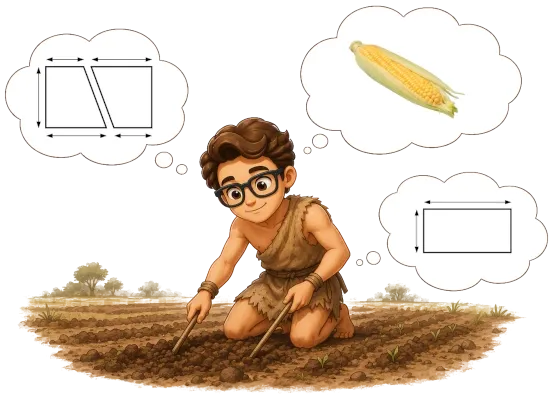
Birth of Rectangles
Rectangles like any other geometric shapes have a long history. Nobody even knows when humanity started to use rectangles and something that requires measurements. Together with triangles and circles, their properties were described in ancient times.
But rectangles are very unique shapes and we hope the reader will forgive us for a statement that rectangles for humanity historically are more important than triangles. Try to guess why? Rectangles are born the moment humanity turned into farmers. Fields are still rectangular today, and will be rectangular for thousands of years to come.
From Hunters to Farmers
For a moment let's forget about uneven shapes and perpendiculars. Humanity started to use rectangles before they started to build houses instead of living in caves. Imagine that yesterday you were a hunter who was just tired of running after mammoths and throwing spears. Alright, you are saying "I'm done".
The same moment you started thinking about how to make some food and how to store it. But before that, you need to plant and harvest it. Yes! You need a field. And because you are not alone, but there is a tribe of your neighbors, you need to make a field that is easy to measure and easy to divide and avoid conflicts. Rectangles are the perfect shapes for it. Voila! The first rectangles were born.
Mathematics of Rectangles
It is just too simple to calculate the area of a rectangle. You just need to multiply the length of one side by the length of the other side. The oldest surviving worked examples of rectangle-area calculations come from Babylonian clay tablets and the Egyptian Rhind Mathematical Papyrus, both dating to roughly 2000-1700 BCE, so it is a very old formula indeed.
Now you have fields, and most likely houses located as close as possible to the fields. Or maybe you have a village with houses and fields.
How the notion of area was invented
Problem of Uneven Steps and Fields
If first farmers used their own feet or steps to measure land, each person would get a different result. One neighbor might count thirty paces across a field, while another counts forty. When land is limited and must be divided fairly, such uneven measurements create confusion and conflict.
The solution was not just to use rectangles, but to agree on a shared unit of length and a simple shape that could be measured consistently. A rectangle is easy to mark with straight sides, easy to divide, and easy to compare with another plot. Once the tribe agreed on common units, it could measure the length and width of a field and calculate how much land each person had.

This is how the mathematics of area began - not from abstract theory alone, but from a practical need to compare harvests, divide land fairly, and prevent arguments about who had more territory.
The rectangle area and its formula developed over the centuries
It took many many years to develop an abstract notion of area.
Babylonians solving field problems on clay tablets, Chinese scientists working out their own formulas, Indian scholars building temples on rectangles of equal area, and later the Greeks proving it all geometrically. They all contributed to the development of the mathematics of rectangles. Rectangles are the perfect shapes for measuring and calculating areas.
The earliest evidence comes from Old Babylonian clay tablets (approximately 4600 years ago), where students solved field area problems.
Independently, Chinese mathematician Jiuzhang Suanshu developed an approach to calculate the area of rectangular and other field types. In India, the Sulba Sutras (approximately 800 - 500 BCE) recorded geometric rules for constructing and combining rectangles of equal area to build temples.
The Greeks took a different route. Rather than treating area as a number produced by multiplication, Euclid proved rectangle-area relationships geometrically. He showed how to geometrically construct a square equal in area to a given rectangle.
Today we know his approach as multiplication of the length of one side by the length of the other. If two different multiplications give the same result, then rectangles have the same area.
Other four-sided shapes
Fields and territories are not the only places where rectangles are used. There are triangles, quadrilaterals, and other shapes, but rectangles are the most used shapes in our daily lives. Modern mathematics has plenty of methods for calculating areas of all known shapes and, correspondingly, their properties.
We have:
- Quadrilaterals
- Rhombuses
- Trapezoids
- And many more, including shapes defined for curved surfaces
Astonishing fact
Today everyone knows how to calculate area of a rectangle. Just multiply the length by the width. But just think about the fact that it took hundreds of years to develop the notion of area and the formula for calculating it!