Sequential or step-by-step mathematical problem solving
Problem solving
Why the step-by-step approach is important
Step-by-step simply means doing something in a sequence of steps. Even though the reader may expect us to focus on mathematics, let us set mathematics aside for a moment and think about the step-by-step approach in general. A related term is the "consecutive" approach. It is a method of solving problems by breaking them down into smaller, manageable steps that are completed in a specific order.
The reader may find many synonyms for this idea, such as sequential, systematic, methodical, and logical. For instance, Gaius Julius Caesar's famous quote, "Veni, vidi, vici" (I came, I saw, I conquered), reflects a step-by-step approach to the problems he faced. Humanity, from the era of cavemen to the present day, has applied this approach to many challenges. Mathematics is one of them.
Al-Khwarizmi, more fully Muhammad ibn Musa al-Khwarizmi, was a Persian scholar and mathematician. His name gave rise to the term "algorithm", which became a foundation of modern computer science.
As the reader knows, algorithms are sequences of predefined steps. Gaius Julius Caesar and Al-Khwarizmi lived centuries apart, but both used step-by-step thinking to solve problems. They were not the first to use this method; they are simply well-known historical figures who illustrate the importance of sequential problem-solving.

Maybe future generations will be solving problems in different ways, but for now, we usually approach them step by step.
- We see a question and try to analyze it. The better we analyze it, the better we understand it. That is an important step in the problem-solving process. If we understand the problem, we can most likely solve it. If we do not understand it, we cannot solve it, or we may choose the wrong direction and reach a dead end.
- Once we understand the problem, we can start thinking about possible solutions. We can define a strategy to solve the identified problem. If we are experienced enough, we may even define a strategy before fully understanding every detail. For instance, we may know how to sum a series of numbers without knowing how to multiply them. But we are quite sure that it is possible to multiply numbers, and we can figure out how to do it later. The important part is that we have a strategy to solve the problem, and we can implement it. Not always, we know the difficulties that we face, but we need to be strong on the way to our goal.
- After we define a strategy, we can implement it and solve the problem by applying that strategy. When it comes to mathematics, we may have a defined formula, but we still need to have an answer.
Without completing the first and second steps, the third step becomes ineffective. In some cases, it may not exist at all. The first and second steps are the most important parts of the problem-solving process. The third step is a consequence of the first two.
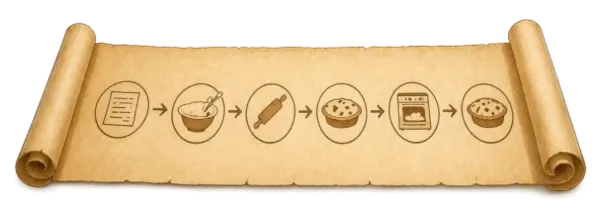
For instance, if we are asked to bake a pie, we first need to understand the task. We need to know what kind of cake we are baking, what ingredients we need, and how to bake it. Even though the author of this example is not a professional baker, they still understand that baking is a sequential process. Let us state the obvious: if we do not know how to bake a cake, we cannot bake it.
The pie is the final product of the process, but the most interesting part is the first two steps. That is why students are often asked to show their work when solving a problem. The final answer is less important than the process used to reach it.

Applications of the step-by-step approach in the real world
We think it is easier to give examples that do not require a step-by-step approach, rather than examples that do require it. It is just everywhere.
- We wake up in the morning, and we already have an algorithm to get ready for the day. The author of this article, for instance, tries to deactivate the alarm as the 1st step, then brushes their teeth as the 2nd step, then looks for a coffee as the 3rd step, and so on. In the most of cases, the ultimate goal of the process is to exit the house and go to work, and this goal is achieved within a step-by-step approach. Getting to work on time is the final goal of the process.
- Fitness plan is another example of a step-by-step approach. We can define a fitness plan to achieve a specific goal, such as building muscle or losing weight. The plan will include a series of steps that are not only sequential. Some of steps may be repetitive, but they are still a part of the algorithm. Following such a plan also requires discipline. If we don't follow the crafted plan, then we will not get to the desired outcome.
What does it mean to be intelligent?
When our brains developed long-term memory, they also developed the ability to store and recall past experiences. At the same time, they gained the ability to solve problems by breaking them down into smaller, manageable steps. This is how mathematics is applied in the real world.
Mathematics is a field that requires a step-by-step approach to problem solving. This makes it easier to understand the problem and find a solution. Even if we don't know how to solve a problem, we can still find a solution by breaking it down into smaller steps. This is waht makes us - the human species - intelligent.
What does it mean to be intelligent? It means that we can solve problems that we never faced before because we can decompose them into smaller, manageable steps and reach a solution.
According to the Cambridge Dictionary, intelligence is "the ability to learn, understand, and make judgments or have opinions that are based on reason."
So, dear reader and students, lets split problems into smaller steps and solve them one by one!
P/S: Our tutor Mathy is a step-by-step problem solver. Sometimes, he is too sequential. Our team is trying to make him a little bit more surprised and unpredictable. But let's discuss this in another article ... let us be authors who write not everything at once but gradually :)