What is the Imaginary Unit? Complex numbers explained simply
Definition of the Imaginary Unit and Complex Numbers
Try to multiply any negative number by itself. Let's take '-1' as an example. If you multiply '-1' by '-1', you get '1'. Don't believe yourself for some reasons? Use any calculator or ask Mathy, the answer will be the same, it is 1. The reverse operation, the square root of '1' is '1'.
Note: many readers also know that the square root of '1' is '-1' as well. This is an absolute truth. But let's omit it for now please since we are talking about the imaginary unit.
Now, let's challenge ourselves with a question. What if we want try to find the square root of '-1' or find a number that when multiplied by itself gives result of '-1'? The reader may say - No way! And this is true, this is what our trained brain whispers or screams to us. The question seems to be doesn't make sense because there is no answer. We know that a negative number multiplied by a negative number always gives a positive number.
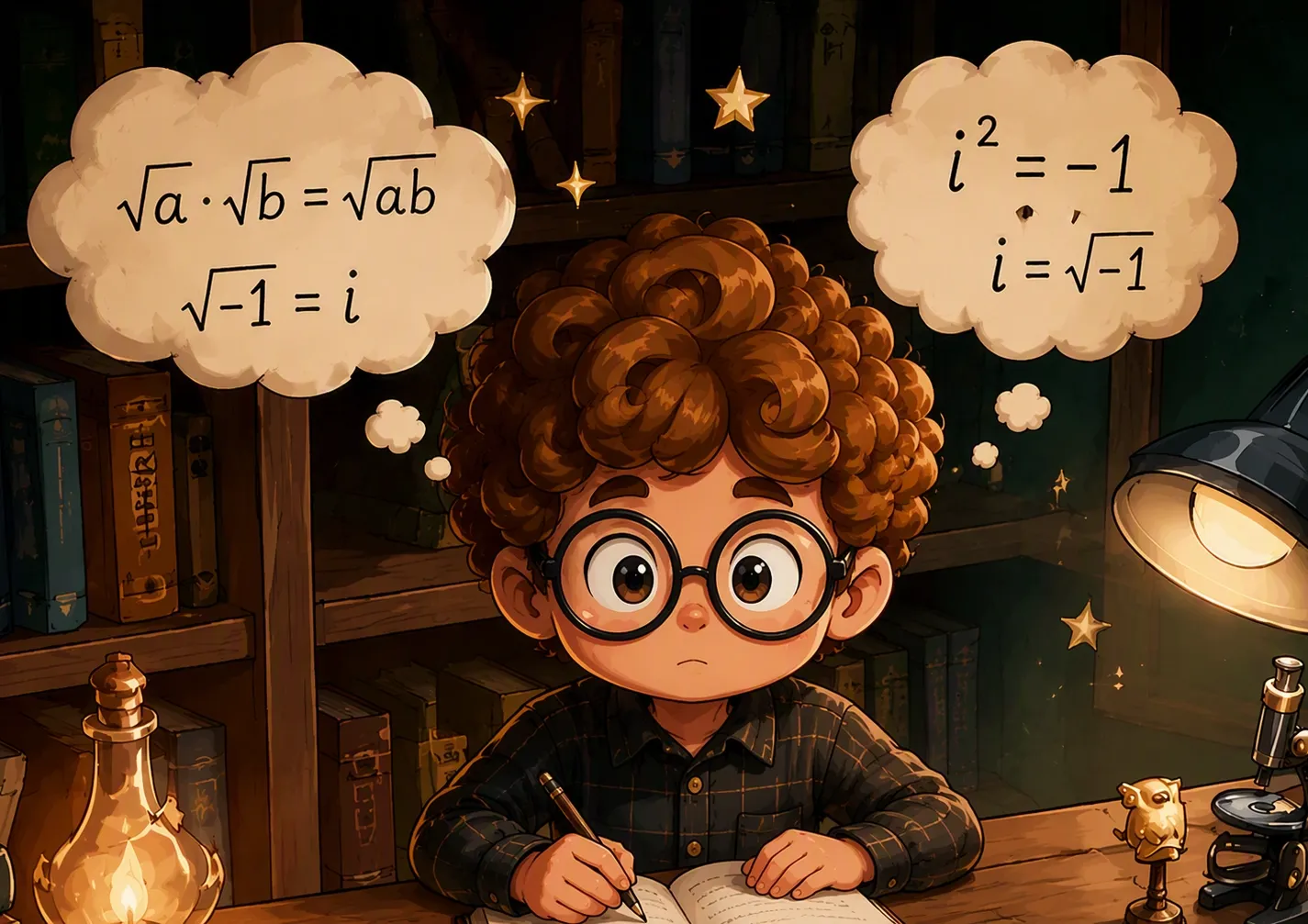
But what if we say that there is a concept and many numbers that break this seems to be a strict rule? ...please do not be surprised, that's not a joke. This is exactly what the imaginary unit is or complex numbers are. When complex numbers are multiplied by complex numbers, they still produce negative numbers (or at least not positive. i.e. <=0). And the most basic complex number, just like '1' in regular mathematics, is the imaginary unit 'i'. This number being raised to the power of 2 gives us '-1'. In other words, that is i * i = -1. And the square root of '-1' is the imaginary unit 'i'.
So, mathematically speaking, the imaginary unit is a number that being multiplied by itself gives the result of '-1'.
And the complex numbers are the numbers that operate with this elementary number. Usually, complex numbers are written in the form of a + bi, where 'a' and 'b' are real numbers or the regular number like '1' or '5', and 'i' is the imaginary unit.
Simple explanation of the necessity of the imaginary unit
Before we explain why the imaginary unit is necessary, let us provide an analogy to prepare the reader's mind.
- Sample analogy: negative numbers
Remember yourself when you were introduced to the concept of negative numbers. Can you have a negative number of chocolate candies? That doesn't make sense until you apply the negative value to something that you measure. Let's say that Matthew has -5 candies relative to Anna. Hm,... that seems to be much more reasonable. ...The next moment when Anna says she has 5 candies, you may immediately understand that Matthew has no candies at all: '5' minus '5' is Zero. Wow! Now, we do understand why we need negative numbers. We need the negative numbers not for a real world, but for a relative world. Though, practically we understand that Matthew physically cannot have a negative number of candies.
Now, let's extend the sweet candy analogy to the imaginary unit. What if we don't have a negative number of candies? It would be a little bit problematic to calculate the actual number of candies that Matthew has relative to Anna. It is still possible but it would require many more calculations and explanations. Imagine that the author of the current article is an air dispatcher and has a task to calculate the position of an airplane relative to another airplane. You are flying to Disney with your family and the dispatcher's goal is to make your flight safe.
The dispatcher has limited time to make an enormous number of calculations. In such and many other cases, they are forced to deal with the square root of negative numbers to make the calculations easier and faster. When the final result is produced, they convert imaginary numbers to real numbers. Thus you will never see the imaginary numbers on the FlightRadar, and you will not see negative altitudes of airplanes. Calculations are done relative to something, but the final results are always converted to the real physical world.
So, we need imaginary numbers to make faster and less complicated calculations.