Who invented triangles and proved the 180 degrees rule
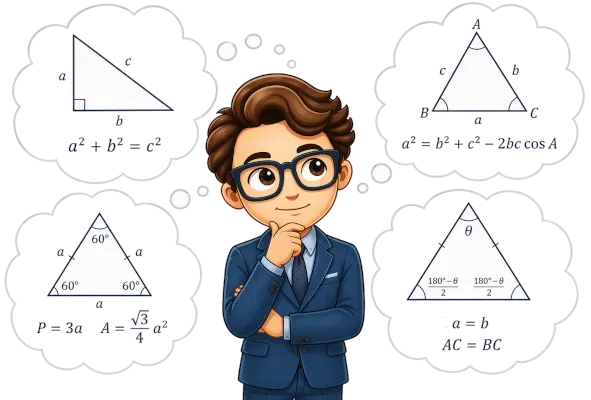
Inventor of triangles
You can't invent a shape that shows up in every mountain or in crystal triangles. What took thousands of years, and a fair amount of argument, was proving what's true about them, that their angles always sum to 180 degrees. So, a quick answer is that humans didn't invent triangles. They just discovered them.
So, triangles themselves are just a shape that exists in nature and geometry, no inventor needed. So, by this moment we can state, and the reader will not be surprised, that nobody ever invented triangles.
You cannot invent something that existed forever or at least since the beginning of time. But the mathematical rules about triangles were discovered and refined over thousands of years by many cultures, not invented by one single person.
However, it took thousands of years of human history and many cups of coffee drunk to develop rules that help us understand and calculate triangles.

Rule of 180 degrees and who discovered it
The discovery is usually credited to the ancient Greeks, though the exact originator is debated among historians. Historians are not mathematicians, so please forgive them. They just solve different than mathematicians problems, but thanks to them we know the following names:
- Pythagoras (or the Pythagoreans), approximately 25 centuries ago
One of the first proofs that the angles of a triangle sum to 180 degrees, not more and not less. The Pythagoras considered this fact as a fundamental geometric knowledge and proved it using parallel lines.
- Thales of Miletus, 26 centuries ago
Some historians believe Thales, who came slightly before Pythagoras, may have known or proven this fact first, since he's credited with several foundational geometry discoveries (like properties of circles and similar triangles). But the historical record is unclear since Thales left no surviving written works.
- Euclid (300 BCE) some 200 years after Pythagoras.
He formalized the rule of 180 degrees and shared an additional proof in his research. Don't forget please that Euclid is considered the "father of geometry", and there is no geometry as an area of mathematics without triangles. Euclid also developed an additional subarea of mathematics using triangle properties. Fear not please ;) It is the trigonometry, which studies the relationships between the angles and sides of triangles.
Regardless of who discovered it first, Euclid gave the definitive, rigorous proof in his book, using the property that a line crossing two parallel lines creates equal alternate angles. This became the standard proof taught for the next 2000 years.
Rule of 180 degrees is not always true
It may sound surprising and even shocking, but the rule of 180 degrees that almost all humans know since the middle school is not always true.
Genius modern mathematicians like Carl Friedrich Gauss, Janos Bolyai, and Nikolai Lobachevsky discovered that on curved surfaces, the angles of a triangle can sum to something that is greater than 180 degrees. Curved surfaces such as Earth surface are not exactly flat, and they break rules of geometry that Euclid formulated. Don't be surprised to know, but on such surfaces even parallel lines intersect. Wow!
Interesting application of triangles
There is a method called "Triangulation" which is used to break down areas into triangles for surveying and mapping. Did you notice in science fiction movies or posts 3D objects are often shown as a mesh or skeletons?

Those are regular triangles. You basically can fill any area or a shape with triangles and leave no gaps. Then independently you can calculate properties of those multiple triangles and understand the properties of the whole area. You cannot do it with other shapes like squares or even hexagons. The tinier the triangles, the more precise your understanding of the area.

Looking for a solution to a problem?
Share you math problem with Mathy. He will guide you to the solution
- Solve with Mathy