Circumference over diameter, the Pi constant and its history
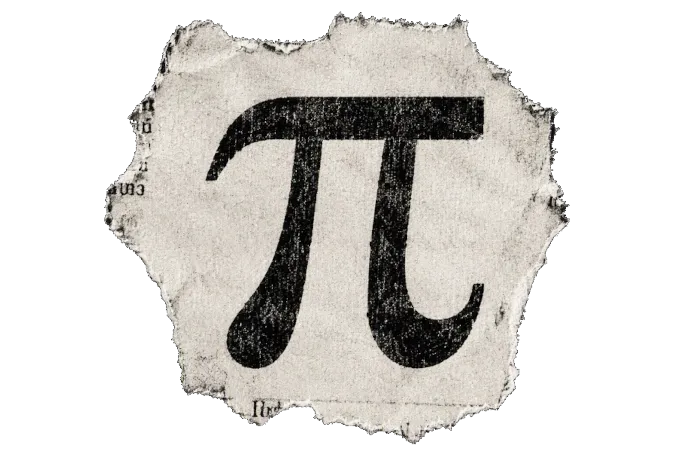
The most recognized mathematical constant
Ask any regular person about a math number, and they will most likely answer "3.14". This is the most recognized mathematical constant, known as π (Pi).
Take any circle's circumference, divide it by its diameter, and you'll always land on the same mysterious constant approximately 3.14 which is known as Pi. But you cannot write it down completely, it's an irrational number that goes on forever without repeating
Defining Pi
Before we define Pi itself, we need to define a circle because Pi is a constant that is related to circles.
A circle is a set of points in a plane that are equidistant from a given point called the center.
And a couple of additional terms:
- The distance from the center to any point on the circle is called the radius (r).
- The distance across the circle through the center is called the diameter (d). So, d = 2 r.
- The circumference (C) of a circle is the distance around it.
Now, we can define Pi as:
The ratio of the circumference of a circle to its diameter. π = C/d, π = C / 2 r
In other words, Pi is the number you get when you divide the circumference of a circle by its diameter.
Discovering 3.14159
Though the value of Pi has been known since antiquity, its research and application were a little bit problematic compared to rectangles. This is because mathematics as any other science took centuries to develop.
Ancient civilizations like the Egyptians and Babylonians had approximations of Pi, but they did not have the tools or methods to calculate it precisely. The Greeks, particularly Archimedes, made significant strides in understanding Pi through geometric methods. He could approximate Pi to the value of 3.14159 by inscribing and circumscribing polygons around a circle. So, five digits after the decimal point were known to the ancient Greeks, and this was a remarkable achievement for the time.
Later, Isaac Newton, the famous English mathematician and physicist, also calculated Pi to 15 decimal places in the 17th century.
It is: 3.141592653589793.
Since then, mathematicians have been trying to calculate Pi to more and more decimal places. The current record is over 31 trillion digits, achieved by a team of scientists using computers.
Note: a trillion is a number with 12 zeros after it (1,000,000,000,000).
What makes Pi so special
The Pi constant is a so-called irrational number. This means that it cannot be expressed as a couple of digits or a fraction of two integers (for instance, 1/2). Pi is not just a number that you can write down on a piece of paper. It may sound weird, but it is impossible to write it down because nobody knows it exactly. The reader may refuse the statement by saying "three point one four ...", but it will not be a complete truth. In daily life, we use a shortened version of the number. But in reality it is a never ending number; it is a so-called irrational number.
Irrational numbers are the numbers that being written in decimal form, have an infinite number of digits after the decimal point that never repeat in a pattern. But good news that even aeronautical engineers do not need that amazing precision. 15 of 16 digits after the comma are enough to make their calculations precise. Coincidence it is or not, but Isaac Newton calculated Pi with enough precision to make space travel possible!
Note: a regular school student is expected to know just 3.14. Two digits after the comma is enough. We all know that mathematics is not only about numbers, first of all it is about the logic and reasoning.
The most important formulas using Pi
It would not be a surprise that the most important formulas in geometry and physics use Pi.

Here are some of them:
- Circumference of a circle: C = 2 πr or C = π d
- Area of a circle: A = π r2
- Volume of a sphere: V = 4/3 π r3
There are many more formulas that use Pi, but the given formulas are considered to be foundational. Project MathWill aims to cover these basics thoroughly and provide deeper guidance whenever it is needed.
Curiosities about Pi
The Pi Symbol as we know it today
Only in 1706 the Welsh mathematician William Jones proposed the use of the Greek letter π to represent the already known 3.14159 constant. It sounds like a joke that the π symbol which is known to the majority of people as a mathematical constant, has a relatively short history.
Just imagine - humanity has been using this constant for centuries, but there was no widely used symbol for it. For instance, the Pythagoras theorem was known for at least 2000 years since the time of Pythagoras.
But the very important and absolutely fundamental constant of 3.141.. had no symbol for it.
The moment William Jones proposed the use of π, it was not widely accepted. 30 years later, in 1737 Leonhard Euler, a Swiss mathematician, started using the symbol in his papers and books. At that time, there was no internet and TV, but mathematicians of the world were already connected by letters and journals, and Euler's influence helped to popularize the symbol.
Birthday of Pi and Albert Einstein
There is a special day in the calendar that is considered to be the birthday of π. As we know the first three digits of π are 3.14, if we try to match them with the calendar, we will find that March 14th is the day of Pi.
March 14th is also the birthday of one of the brilliant physicists of the 20th century if not humanity as a whole. It is Albert Einstein. He was born on 14th March 1879.