Same math, different division and multiplication ways
Same math, different notation
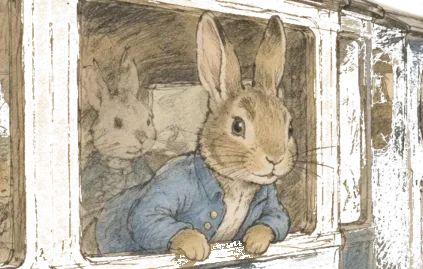
MathWill is an international project, and we are always looking for ways to make math more accessible to children around the world. In this article we compare how children in different countries write the division and multiplication calculations on paper by using a simple problem about Peter Rabbit and his friends.
The math stays the same, but the graphical ways to solve the problem are different.
Problem with a train and seats / meet the travelers
Let us introduce the problem with a story to make it more engaging and practical at the same moment.
Peter Rabbit is planning a trip with his friends. The train has 250 seats, and Peter's group always travels together.
- Peter Rabbit himself
- Flopsy
- Mopsy
- Cottontail
- Mrs. Rabbit
- Mr. McGregor
Question:
Will everyone fit? If so, how many Rabbit groups can travel on one train, and is there anyone left behind?
Working it out means solving a division problem with a twist: a so-called remainder.
Solution
Step 1: Identify the numbers and the operation
Now let's solve this problem together.
Peter Rabbit and his friends travel in groups, and the train has 250 seats. We want to know how many full groups can fit into 250 seats.
In this problem:
- Dividend: 250 is the total number of seats on the train
- Divisor: this is the number of travelers in each Rabbit group. So it is 6.
The question is asking how many times 6 can fit into 250. This is a division problem, and we can find the answer by performing the division 250 ÷ 6.
Step 2: Perform the division and obtain the answer
Depending on where you live and how you were taught, you may have learned different ways to perform division. Here are three common methods:

- Bracket method or long division method. Is used in the UK, US, South Korea, and India. The divisor sits to the left of a bracket, with the quotient written above. The UK calls this the "bus stop method"; it is the same idea, just with a slightly different bracket shape. The name comes from the shape of the bracket itself, which looks a bit like a bus shelter roof. For bigger dividends, each digit is brought down one at a time, and the multiplication result is subtracted directly underneath it before moving to the next digit.
- Dutch method. Called "staartdeling" (tail division): written as divisor \ dividend / quotient on one line, with the subtraction worked out underneath like a tail. It gets its name because, for larger numbers, each step of subtracting and bringing down the next digit adds another segment below the line, so the working trails downward like a tail. The quotient digits are written one at a time, right after the slash, as each one is worked out.
- "Russian" method. Called division "by the corner". It is not a Russian method, it is rather a western european way. The dividend and its subtraction stay on the left of a vertical line, while the divisor and quotient sit on the right. The vertical line and the short horizontal line under the divisor together form an "L" shape, or corner, which is where the method gets its name. This same layout is also common in several other Eastern European and post-Soviet countries.
Every method above lands on the same answer: 6 goes into 250 a total of 41 times (since 41 × 6 = 246), which leaves a remainder of 4.
We write the full result like this:
250 ÷ 6 = 41 and 4 is remainder
So:
- 41 full Rabbit groups can fit on the train.
- 4 seats are left over.
Note: there are other ways children can visualize division. We have included just a few common methods here to keep the idea of the article clear. If the reader would like to see more visual explanations, please contact us.
Final step: check the math with the multiplication
Now, let’s check the math:
We multiply the number of groups by the number of travelers in each group:
41 × 6 = 246

- In the UK, US, South Korea, and Russia, this is written as long multiplication: the same stacked, shifted-partial-product layout used for bigger numbers.
- In the Netherlands, the "kolomsgewijs vermenigvuldigen" (column multiplication) method writes each partial product out in full, with the operator trailing the number, the same way staartdeling (division) writes its subtraction step.
That means 246 seats are used.
But we know that the train has 250 seats, so we can find out how many seats are left over:
250 - 246 = 4
So, the train can fit 41 full groups of Peter Rabbit and his friends, and there are 4 seats left over.
The leftover number is called the remainder. In this problem, the remainder is 4. This is a good example of division with remainder, because 250 cannot be split into equal groups of 6 without having a few seats left over.
Division with remainder: why it matters for kids
Division with a remainder is a key idea in arithmetic.
The moment children start to understand it, they are often confused. For instance, the author of this article remembers being confused when he first learned that on average bus can carry 80.5 passengers. How can half a person travel on a bus?
Children study how to split a number into parts and see what is left over. But the real motivation is not the calculation itself. It is helping kids develop a sense of numbers and how they relate to each other.
It is a foundational mathematical skill. The moment we learn to divide our environment into pieces, we start to interpret it more deeply.
Real-world examples:
- Apples are sold in bags by weight.
- Days are measured in time intervals.
- Candies are sold in boxes.
- Rabbit Group is a single unit of travelers, but it is made up of 6 individual rabbits.
Note: apples, time intervals, and candies can still be split further. But for the simplicity of this problem, we can treat them as indivisible.
Understanding the remainder is what turns division from a rigid, all-or-nothing operation into a tool that actually matches how the world works, where things rarely split up perfectly evenly. Whether it is rabbits travelling on trains, apples packed into bags, or candies sorted into boxes, the remainder is the part of the answer that tells the full story. Learning to spot it is just as important as learning to divide.