Speaking the universal math language and its symbols
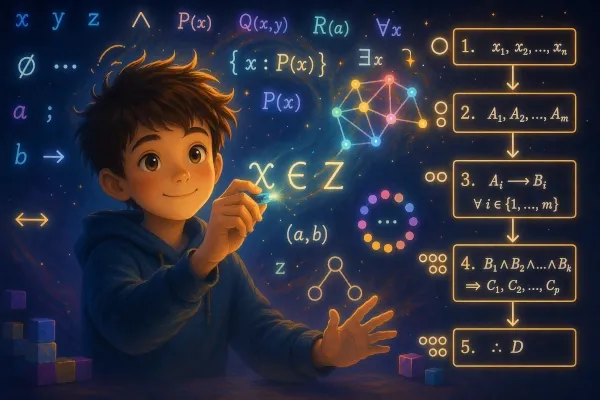
A language that everyone shares
Living in the current world means speaking or at least reading in different languages Even if you try you cannot avoid it. There many more tongues than the languages. It makes the planet sound differently everywhere. We need to admit the fact that the current human civilization is multi-language. And it creates many many problems.
There are many languages but one language we normally omit because it is a so-called formal language of mathematics. It has not accents, sound, or even a country of origin.
What makes a language "formal"?
By the way, a formal language is the rules for making words or sentences. It is very strict compared to a regular spoken language. If you make a mistake using its alphabet then it is almost immediately seen.
Can mathematicians understand each other without words?
If you and your friend speak different languages but you are both mathematicians, then you can understand each other even without pronouncing a single word. The reader can debate such a statement and, in some way, will be right. It can be complicated.
Those who can speak or use this language can just sit across a table and fill a piece of paper with symbols and understand each other. This is astonishing!
The language of mathematics is not a simple language. It requires having extensive knowledge, but if you can master it, then it is with you forever. Just imagine, humanity started to develop the vocabulary of mathematical notation thousands of years ago in different parts of the globe. And humanity still improves its vocabulary by improving the science and engineering.
Well-known math words
Mathematicians across the world though about similar problems long before we were born, and finally we can easily use the words that they created. These words are not the "integral" and "differential equation". Uph, these words already sound scary ;)
Open a textbook somewhere in California, look at the whiteboard somewhere in Athens, look at the kids books somewhere in a bookstore in Seoul. Everywhere you will find these symbols. They have no dialect, no specific pronunciation. They are amazingly simple yet have a long history.
For instance, "+", "-", or simple characters like "1", "2". Nowadays, these symbols are the same in all languages. Just open any book, any internet page, or simply look what children draw on papers and send to each other in messengers. These symbols still will be the same.

There are other words that almost every human knows, yet they are a part of the same formal math language:
- sum, difference, product, quotient
- equation, expression
- area, perimeter, volume
- fraction, decimal, percent
- graph, coordinate
- ratio, proportion
Are there any other universal languages?
Today we have Computers and Artificial Intelligence, and these areas also have their formal language which develops with an enormous speed. Every day, new commands and programs appear, and yet, somehow, a programmer in London can read the code written by a programmer in Tokyo without knowing a single word of Japanese.
Yes, the language of computer science is also a universal formal language.